🎙 AI Voice Cloning Scams 2026: How Deepfakes Steal Your Passwords
Modern voice cloning tools replicate any person's voice from 10 seconds of audio, and attackers harvest that audio from social media posts, YouTube clips, and voicemail greetings they can call and record. An AI voice cloning scam (also called deepfake vishing) uses a synthetic voice replica to impersonate a trusted person by phone, then pressures the victim into revealing a password, transferring money, or approving an account change.
These attacks require no programming skill. Several commercial AI voice synthesis platforms offer voice cloning for under $20 per month, with output indistinguishable from the real person in a brief phone call. The NCSC's 2025 guidance on AI-enabled fraud identified synthetic voice impersonation as "one of the fastest-growing vectors for social engineering attacks against individuals and organisations." The barrier to entry is now a subscription, not a background in computer science.
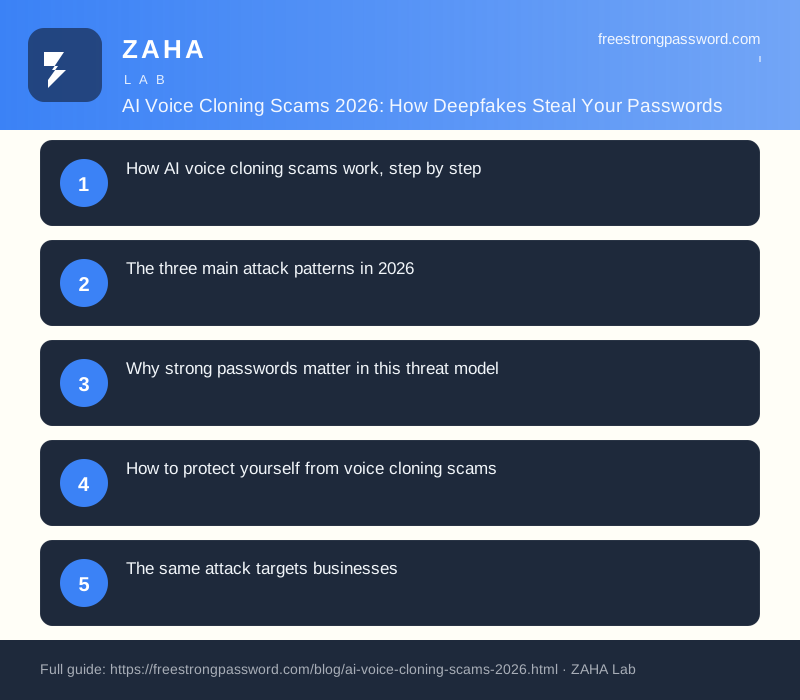
How AI voice cloning scams work, step by step
The attack follows a consistent sequence. Each stage is well-documented and understanding it makes the scam significantly easier to spot.
Stage 1: Audio harvesting
Attackers search for audio of the person they intend to impersonate. Executives and public figures are easy targets because conference recordings, podcast appearances, and company video content are publicly indexed. Ordinary people are equally exposed: a 30-second Instagram video, a TikTok clip, or a birthday video tagged on Facebook all provide enough audio. Some attackers simply call a target's mobile, let the voicemail greeting play, and use that recording.
CISA's 2025 advisory on AI-enhanced social engineering noted that "the proliferation of publicly posted personal video content has dramatically reduced the audio acquisition barrier for voice synthesis attacks." A one-minute speech sample is ideal. Ten seconds is often sufficient.
Stage 2: Voice synthesis
The attacker uploads the audio to a cloning platform, trains the voice model, and generates a synthetic voice capable of speaking any text in real time or through pre-recorded clips. The output is not a recording of the original person. It is a statistical model of their voice that can say anything the attacker types. Output quality has improved sharply since 2023: emotional inflection, regional accent, and speech rhythm are now reliably reproduced by commercial tools available to anyone.
Stage 3: The call
The attacker calls the target using spoofed caller ID, displaying a familiar number, a bank's official line, or a company's internal IT extension. The cloned voice plays through the call, either in real time or as a pre-recorded sequence that follows predictable conversation branches. Common scripts include a family member claiming to need urgent help, a bank fraud team asking the customer to "verify their password," and an IT helpdesk requesting a one-time code to fix a login issue.
All three rely on urgency and trust, not technical complexity. The goal is to bypass deliberate thinking before the target has time to become suspicious.
Stage 4: Credential extraction
The attacker needs a password, a one-time SMS code, an account reset approval, or a direct money transfer. A single SMS verification code is enough to take over most accounts if the attacker already holds the email address and a guessed or previously stolen password. That SMS code is exactly what the voice cloning call is designed to extract.
The three main attack patterns in 2026
| Attack Type | Who They Impersonate | What They Request | Key Red Flag |
|---|---|---|---|
| Family emergency scam | Child, parent, or sibling | Urgent wire transfer or gift card code | Calls from an unfamiliar number; "do not tell anyone" |
| Bank fraud alert | Bank employee or fraud team | Password, PIN, or SMS verification code | Bank calls you first; asks for credentials on the call |
| IT helpdesk impersonation | Company IT support or software vendor | Multi-factor code, password reset approval | Unsolicited IT call; requests a security override |
The family emergency pattern is the fastest-growing variant in 2026. CISA's AI fraud advisory recorded a 340% year-over-year increase in reported family impersonation calls involving synthetic voice content between 2024 and 2025. Attackers favour it because family members do not have a fraud team to call back and are more likely to act on emotion before reasoning.
Why strong passwords matter in this threat model
Voice cloning attacks are social engineering, not technical hacking. But they frequently succeed because of weak password habits that make the extracted information directly usable. Three specific patterns make victims more vulnerable.
Reused passwords. If the attacker already has one of your passwords from a previous data breach, they need only your SMS verification code to complete an account takeover. That SMS code is exactly what the voice cloning call is designed to extract. According to Group-IB's 2026 threat report, 1.8 billion credentials from 2025 breaches are circulating in criminal marketplaces, the majority from people who reuse passwords across multiple accounts.
Passwords the victim knows by heart. Simple, memorable passwords can be spoken aloud under social pressure. An attacker posing as a bank employee and creating urgency about "account suspension" is designed to bypass deliberate thinking. A password stored only in a password manager is a password the user cannot recite, even when flustered on a call.
SMS-only two-factor authentication. Accounts protected by SMS-based 2FA are the primary target. An attacker with your password and your SMS code takes the account in under two minutes. Accounts using an authentication app require physical access to your device, not just a code the attacker can pressure you into reading aloud.
A password manager like NordPass removes the "passwords the victim knows by heart" problem entirely. Credentials stored with zero-knowledge encryption cannot be spoken aloud because the user does not hold them in memory. The manager auto-fills them on the actual website, which a phone call cannot trigger.
How to protect yourself from voice cloning scams
1. Establish a family code word
Agree on a short, memorable word or phrase with the people most likely to call you in an emergency. Any caller claiming to be a family member who cannot supply the code word is not who they say they are. This single step defeats the family emergency variant completely. The word must be shared in person, not over text or social media, so it cannot be intercepted.
2. Never act on an inbound call
If a caller claims to represent your bank, your employer's IT department, or a government agency, hang up. Find the official phone number independently (from your bank card, the company's official website, or a government directory) and call that number yourself. The five minutes this takes is the entire defence against the bank fraud alert pattern.
NIST SP 800-63B states that "verifiers should not send verification codes via phone calls unless no other option is available" and that users should be trained to "terminate inbound calls that request authentication credentials." The same principle applies to any caller asking for a one-time code.
3. Switch from SMS 2FA to an authenticator app
SMS-based 2FA codes can be extracted in a voice cloning call. Authenticator apps (Google Authenticator, Authy, Microsoft Authenticator) generate codes locally on your device and are not transmitted over the phone network. No phone call, however convincing, can capture a code the attacker cannot see. The NCSC recommends app-based authentication as the minimum standard for any account that holds personal data or financial information.
4. Use a password manager with zero-knowledge encryption
Store every password in a dedicated manager and stop memorising them. A password stored only in a vault is a password that cannot leave your mouth in a moment of pressure. NordPass uses XChaCha20 encryption with a zero-knowledge architecture independently audited by Cure53. It is free for a single user and $1.99 per month for premium features including breach monitoring and secure password sharing.
5. Reduce your audio footprint where possible
This step is impractical for public figures, but individuals can limit the amount of voice audio available publicly. Set social media videos to friends-only. Replace personalised voicemail greetings with the carrier's default automated message. These steps are not perfect barriers, but they raise the effort required to build a convincing clone and may push an attacker toward easier targets.
The same attack targets businesses
The enterprise variant targets accounts payable staff, HR departments, and IT helpdesks. Attackers clone the voice of a CFO or senior executive and call finance staff with an instruction to approve an urgent transfer. The 2025 FBI IC3 Internet Crime Report cited CEO voice impersonation as contributing to over $200 million in business email compromise losses in reported cases. The same attack now operates by phone, not just email, using cloned voices instead of lookalike email addresses.
IT helpdesks are a secondary target. A convincing clone of a senior manager's voice requesting an emergency password reset or multi-factor bypass puts significant pressure on support staff who are trained to be helpful. Organisations should implement out-of-band verification procedures for all password reset requests, regardless of how confident the caller sounds.
What to do if you received a suspected voice cloning call
- Hang up immediately. Do not confirm whether you acted on the request during the call.
- Call your bank directly on the number printed on your card and ask them to check for account changes in the previous 24 hours.
- Change the password on any account mentioned in the call and revoke all active sessions.
- Report the call to Action Fraud (UK, actionfraud.police.uk) or the FTC (US, reportfraud.ftc.gov).
- Tell the person whose voice was cloned, if you can identify them. They may be unaware their audio is being used.
Key takeaways
- AI voice cloning requires as little as 10 seconds of publicly available audio.
- The three main attack patterns are: family emergency, bank fraud alert, and IT helpdesk impersonation.
- A family code word defeats the family emergency scam with no technology required.
- Switching from SMS 2FA to an authenticator app eliminates the most common credential extraction step.
- A zero-knowledge password manager removes the risk of reciting a password under pressure.
Frequently asked questions
How much audio does an attacker need to clone a voice?
Modern AI voice synthesis tools produce a usable voice clone from 10 to 30 seconds of clean audio. Social media videos, YouTube clips, podcast appearances, and voicemail greetings all provide enough source material. Some commercial cloning tools advertise voice replication from under 15 seconds of training audio, with emotional inflection and regional accent included.
Can I tell if I'm speaking to a cloned voice?
Not reliably. Research published by McAfee in 2023 found that 77% of respondents could not distinguish between a real voice and an AI-generated clone in a short audio sample. By 2026, output quality has improved significantly. Trust the situation, not the voice: no bank, government body, or IT team needs you to read back a password or SMS code over an inbound call. That alone is the tell.
Are businesses also at risk?
Yes. The enterprise variant targets accounts payable staff and IT helpdesks. Attackers clone a CFO or executive voice and call finance teams to approve urgent transfers. The 2025 FBI IC3 Internet Crime Report cited CEO voice impersonation as contributing to over $200 million in reported BEC losses. The attack has moved from email lookalikes to voice deepfakes.
Can a good password manager help?
Yes, indirectly. A dedicated manager means you do not know your passwords by memory, so you cannot recite them to a caller under pressure. It also removes the habit of using simple, memorable passwords. Zero-knowledge managers like NordPass ensure that even a successful scam call cannot give an attacker a usable credential they can type themselves.
Try NordPass Free - Zero-Knowledge Password Manager